The Flight into Egypt (Elsheimer)
Adam Elsheimer · 1609
The story
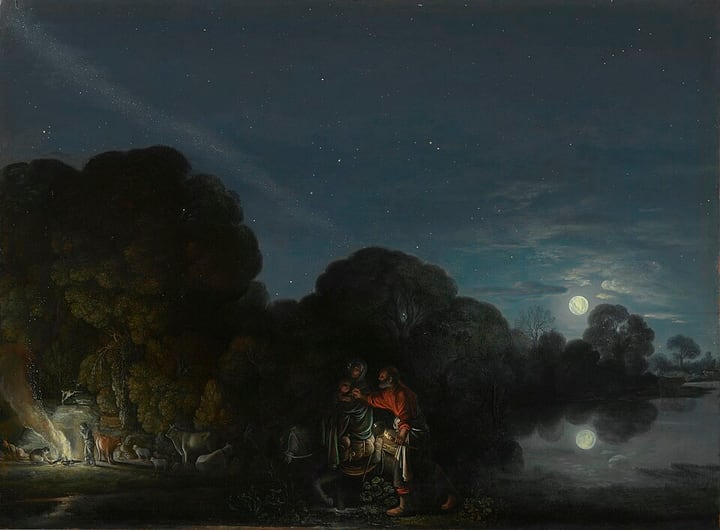
The Flight into Egypt is an oil-on-copper cabinet painting by the German artist Adam Elsheimer dating from about 1609, while he was in Rome. It is thought to be the first naturalistic rendering of the night sky in Renaissance art. At Elsheimer's death in Rome in 1610, this picture was hanging in his bedroom.
Like many other artists before and after him, Elsheimer has depicted the biblical Flight into Egypt, in which Joseph, Mary, and Jesus seek refuge from possible persecution by Herod. For its innovative fusing of religious and landscape elements, and its detailed juxtaposition of light and darkness, The Flight into Egypt is one of Elsheimer's most well-known and lauded works. It is also likely his last painting, for he died a year later.
Elsheimer's treatment is unique in placing the Holy Family in a nocturnal setting, true to the biblical description. The darkness creates opposing feelings of intimacy and fear of the unknown. The painting channels the mysteries of night, pondered by humans for centuries, into this moment of the Holy Family seeking refuge.
There are four sources of light in the painting: the Moon is accurately depicted and reflects off the calm water. There is a fire near the shepherds at left, where the family is headed. At the centre of the composition, Joseph holds a torch that illuminates Mary and the infant, who are riding an ass. The heavily treed landscape behind them is almost black, its outline forming a diagonal across the sky and completely containing the foreground figures. The diagonal is echoed in the night sky by the intricate band of the Milky Way, and detailed configurations of stars are seen, including Ursa Major at far left. Elsheimer is thought to be the first painter to accurately depict constellations. Another readily identifiable constellation is Leo, above the Holy Family, with its brightest star, Regulus, in the centre of the picture. It has been proposed that Elsheimer reworked the painting in 1610, after the publication of Galileo's Sidereus Nuncius, which showed the Milky Way as composed of individual stars and showed the Moon's surface in unprecedented detail. This hypothesis has been contested by Elsheimer scholar Keith Andrews.
In addition to disclosing Elsheimer's interest in scientific topics, the appearance of the Milky Way has a spiritual connotation—it symbolized the path to heaven beginning in the Middle Ages. Elsheimer's sky, wrote art historian R. H. Wilenski, "is no longer a blackcloth but a symbol for boundless space".
- Artist
- Adam Elsheimer
- Date
- 1609
- Collection
- Bavarian State Painting Collections, Munich, Germany
- Movement
- Baroque, Mannerism
- Medium
- copper, oil paint
- Size
- 30.6 × 41.5 cm
Story adapted from the Wikipedia article and its contributors, licensed under CC BY-SA 4.0. Facts from Wikidata (CC0). Image: Public domain, Wikimedia Commons.
_2.jpg)
Explore paintings by Adam Elsheimer
Explore related paintings
- The Sin (Stuck) by Franz von Stuck
- Allegory of Virtue and Vice (Veronese) by Paolo Veronese
- Battle of Lepanto by Paolo Veronese
- Charles I at the Hunt by Anthony van Dyck
- Finding of the Body of Saint Mark by Jacopo Tintoretto
- Laocoön (El Greco) by El Greco
Guess famous paintings in the free daily art puzzle →
Enable JavaScript to play the interactive puzzle. Your progress stays on this device.