Pallas and the Centaur
Sandro Botticelli · 1482
The story
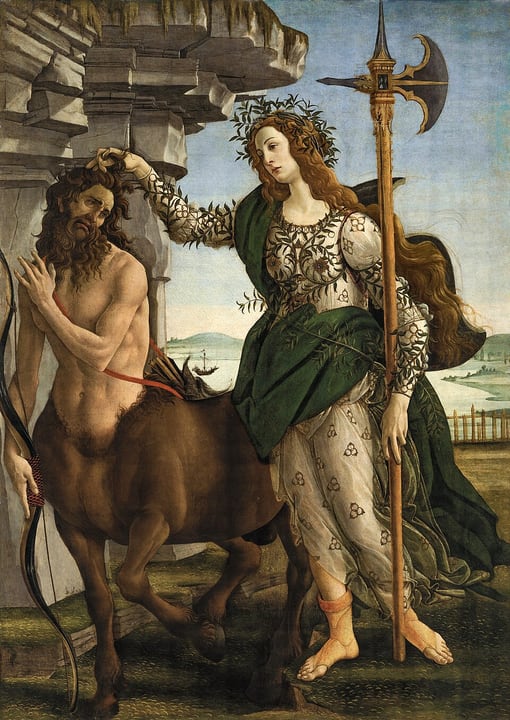
Pallas and the Centaur is a painting by the Italian Renaissance painter Sandro Botticelli, c. 1482. It is now in the Uffizi Gallery in Florence. It has been proposed as a companion piece to his Primavera, though it is a different shape. The medium used is tempera paints on canvas and its size is 207 x 148 cm. The painting has been retouched in many places, and these retouchings have faded.
The life-size figures are from classical mythology and probably form an allegory. There is a centaur on the left, and a female figure holding a very elaborate halberd on the right. She is clutching the hair of the centaur, who was evidently about to shoot from his bow. The female figure was called Camilla in the earliest record of the painting, an inventory of 1499, but in an inventory of 1516 she is called Minerva, the Roman equivalent of Pallas Athene; Pallas remains her usual modern identification, but Camilla has supporters. Arthur Frothingham suggested that she is Florencia, the personification of the city of Florence. The fine cloth of her dress is decorated with the Medici's three-ring insignia.
A figure specifically originating from Roman mythology, Camilla was a princess raised in the forest by her father, the exiled King Metabus, to be dedicated to Diana as a virgin warrior huntress, for whom subduing a centaur might be considered ordinary. Pallas/Minerva, by contrast, is a major deity, representing wisdom, trade, and more. Centaurs are associated with uncontrolled passion, lust and sensuality. The painting's meaning is clearly at least in part about the submission of passion to chastity and/or reason. Various more specific personal, political and philosophical meanings along these general lines have been proposed.
- Artist
- Sandro Botticelli
- Date
- 1482
- Collection
- Uffizi Gallery, Florence, Italy
- Movement
- Early Renaissance
- Medium
- oil paint
- Size
- 205 × 147.5 cm
Story adapted from the Wikipedia article and its contributors, licensed under CC BY-SA 4.0. Facts from Wikidata (CC0). Image: Public domain, Wikimedia Commons.
.jpg)
Explore paintings by Sandro Botticelli
Explore related paintings
- Adoration of the Magi by Sandro Botticelli
- Calumny of Apelles by Sandro Botticelli
- Madonna of the Magnificat by Sandro Botticelli
- Primavera by Sandro Botticelli
- The Birth of Venus by Sandro Botticelli
- Adoration of the Magi (Dürer) by Albrecht Dürer
Guess famous paintings in the free daily art puzzle →
Enable JavaScript to play the interactive puzzle. Your progress stays on this device.