September Morn
Paul Émile Chabas · 1912
The story
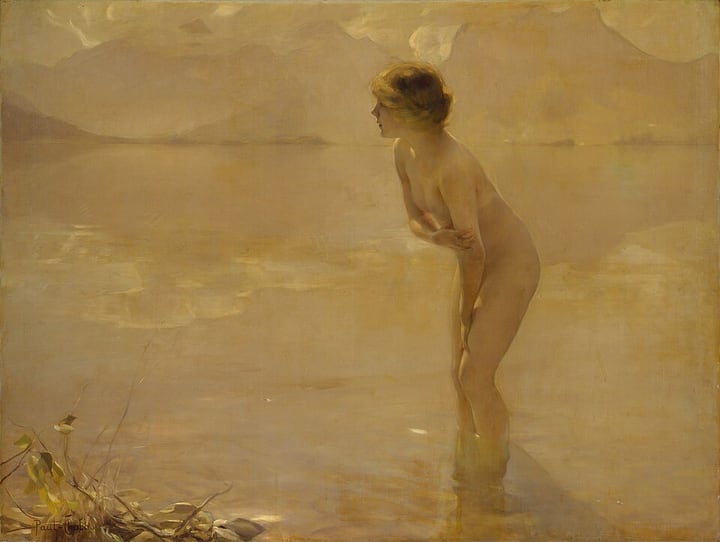
Matinée de Septembre (English: September Morn) is an oil painting on canvas completed in 1911 by the French artist Paul Émile Chabas. Painted over several summers, it depicts a nude girl or young woman standing in the shallow water of a lake, prominently lit by the morning sun. She is leaning slightly forward in an ambiguous posture, which has been read variously as a straightforward portrayal of protecting her modesty, huddling against the cold, or sponge bathing. It has also been considered a disingenuous pose permitting the "fetishisation of innocence".
September Morn was first exhibited at the Paris Salon of 1912, and although the identity of its first owner is unclear, it is certain that Leon Mantashev acquired the painting by the end of 1913. It was taken to Russia, and in the aftermath of the October Revolution of 1917 was feared lost. It resurfaced in 1935 in the collection of Calouste Gulbenkian, and after his death in 1955 was sold to a Philadelphia broker, who donated it anonymously to the Metropolitan Museum of Art (the Met) in 1957. As of 2014 it is not on display.
From 1913 on, reproductions of the painting caused controversy in the United States. An art dealer in Chicago was charged with indecency and another in New York was targeted by anti-vice crusader Anthony Comstock, both after displaying September Morn. Over the next few years the work was reproduced in a variety of forms, including on pins and calendars, while censorship and art were debated in newspapers. Chabas' painting inspired songs, stage shows and films; eventually some 7 million reproductions were sold, though Chabas – who had not copyrighted September Morn – did not receive any royalties.
Although several women claimed to be the model for September Morn, Chabas never revealed her identity. He described the work as "all I know of painting", and responded positively to statements that it was his masterpiece. Later writers, however, have described the painting as kitsch, valuable only as a historic artifact.
- Artist
- Paul Émile Chabas
- Date
- 1912
- Collection
- The Met, New York, United States
- Medium
- oil paint, canvas
- Size
- 163.8 × 216.5 cm
Story adapted from the Wikipedia article and its contributors, licensed under CC BY-SA 4.0. Facts from Wikidata (CC0). Image: Public domain, Wikimedia Commons.

Explore paintings by Paul Émile Chabas
Explore related paintings
- A Goldsmith in His Shop by Petrus Christus
- Adoration of the Shepherds (Mantegna) by Andrea Mantegna
- Annunciation (Memling) by Hans Memling
- Beauty Revealed by Sarah Goodridge
- Bélizaire and the Frey Children by Jacques Amans
- Esther Before Ahasuerus (Artemisia Gentileschi) by Artemisia Gentileschi
Guess famous paintings in the free daily art puzzle →
Enable JavaScript to play the interactive puzzle. Your progress stays on this device.