Honeysuckle Bower
Peter Paul Rubens · c. 1609
The story
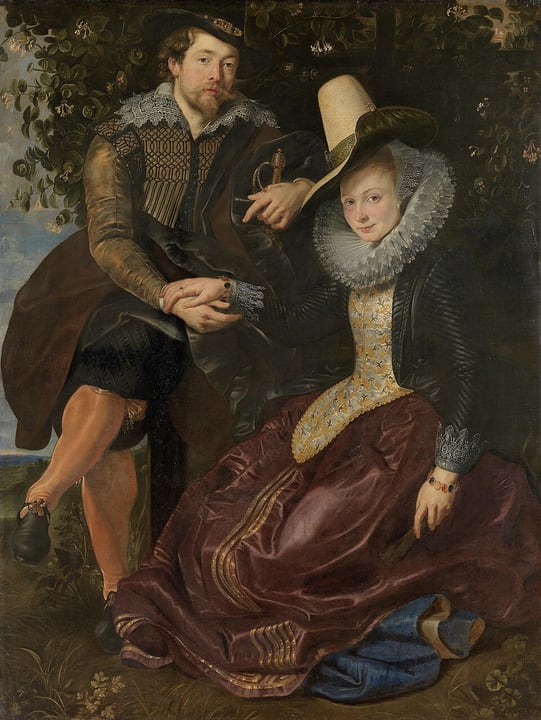
The Honeysuckle Bower is a self-portrait of the Flemish Baroque painter Peter Paul Rubens and his first wife Isabella Brant, painted c. 1609.The couple is seated in fine clothes within a garden composition and a vine of honeysuckle is placed overhead. The symbolism of the double-portrait alludes to meanings of love and marriage, such as the holding of right hands (dextrarum iunctio), and the concept of the garden of love. The pose of the two figures and their fine clothing signify self-fashioning by Rubens. They wed in 1609, the same year that work was created; it was ultimately given to Isabella's father Jan Brant and would later end up in the collection of Johann Wilhelm II of Düsseldorf. The couple would be married for seventeen years, and have three children before Isabella died in 1625. Her death would have a profound impact on Rubens and through his loss he created an posthumous portrait.
- Artist
- Peter Paul Rubens
- Date
- c. 1609
- Collection
- Alte Pinakothek, Munich, Germany
- Medium
- oil paint, canvas, oak panel
- Size
- 178 × 136.5 cm
Story adapted from the Wikipedia article and its contributors, licensed under CC BY-SA 4.0. Facts from Wikidata (CC0). Image: Public domain, Wikimedia Commons.

Explore paintings by Peter Paul Rubens
Explore related paintings
- Medusa (Rubens) by Peter Paul Rubens
- Samson and Delilah (Rubens) by Peter Paul Rubens
- The Descent from the Cross (Rubens, 1612–1614) by Peter Paul Rubens
- The Elevation of the Cross by Peter Paul Rubens
- The Three Graces (Rubens, Madrid) by Peter Paul Rubens
- Children Eating Grapes and a Melon by Bartolomé Esteban Murillo
Guess famous paintings in the free daily art puzzle →
Enable JavaScript to play the interactive puzzle. Your progress stays on this device.