The Immaculate Conception (Tiepolo)
Giovanni Battista Tiepolo · 1767
The story
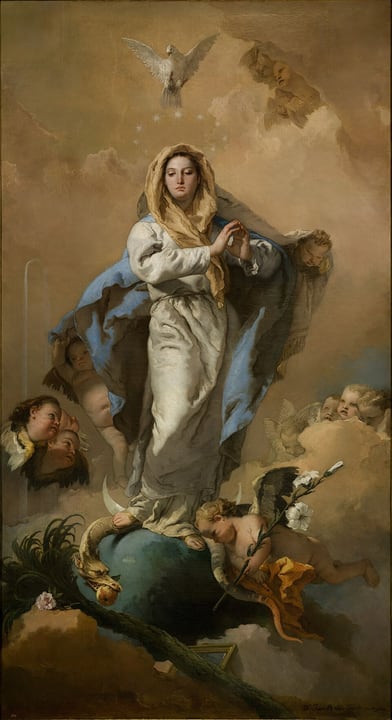
The Immaculate Conception is a painting by Italian painter Giovanni Battista Tiepolo (1696–1770). The painting was one of seven altarpieces commissioned in March 1767 from Tiepolo by King Charles III of Spain for the Church of Saint Pascual in Aranjuez, then under construction. This was originally an Alcantarine (Franciscan) monastery that was later assigned to the Conceptionist nuns.
The painting was commissioned in 1767, at a time when the Immaculate Conception was already a common theme in Ecclesiastical art, the Feast of the Immaculate Conception (8 December) having been restored to the Calendar of Saints in 1708, though its theology would not be definitively settled as dogma until Pope Pius IX's declaration in 1854. It represents the Immaculate Conception, a tradition of the Catholic Church stating that the Virgin Mary was conceived without original sin. It depicts the Virgin Mary, surrounded by angels and crowned with the circle of stars. She is shown trampling a snake, representing her victory over the devil. The lilies and the rose are references to hortus conclusus ("enclosed garden"), and symbolize Mary's love, virginity and purity. The painting is now in the Prado Museum, Madrid.
Tiepolo's altarpieces were transferred to the adjoining convent soon after they were installed in the church. They were replaced by an identically themed set by Anton Raphael Mengs, whose neo-classicism was more to Charles III's taste. Finally The Immaculate Conception was transferred to the Prado Museum in 1827.
- Artist
- Giovanni Battista Tiepolo
- Date
- 1767
- Collection
- Museo del Prado, Madrid, Spain
- Medium
- oil paint, canvas
- Size
- 279 × 155 cm
Story adapted from the Wikipedia article and its contributors, licensed under CC BY-SA 4.0. Facts from Wikidata (CC0). Image: Public domain, Wikimedia Commons.

Explore paintings by Giovanni Battista Tiepolo
Explore related paintings
- Agnus Dei (Zurbarán) by Francisco de Zurbarán
- Annunciation (Fra Angelico, Madrid) by Fra Angelico
- Charles IV of Spain and His Family by Francisco Goya
- Death of the Virgin (Mantegna) by Andrea Mantegna
- Doña Joanna the Mad by Francisco Pradilla y Ortiz
- Hercules and the Hydra (Zurbarán) by Francisco de Zurbarán
Guess famous paintings in the free daily art puzzle →
Enable JavaScript to play the interactive puzzle. Your progress stays on this device.