Woman in the Garden
Claude Monet · 1867
The story
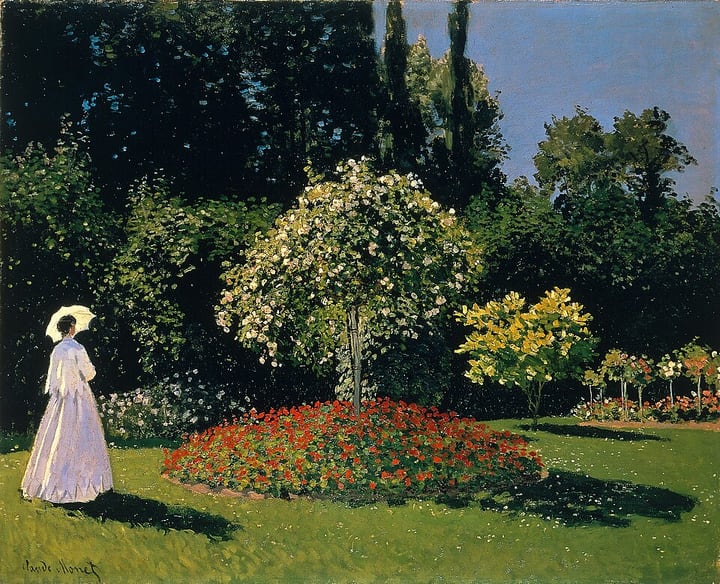
Woman in the Garden (French: Femme au jardin) (or Jeanne-Marguerite Lecadre in the Garden) is a painting begun in 1866 by Claude Monet when he was a young man of 26. The work was executed en plein air in oil on canvas with a relatively large size of 82 by 101 cm. and currently belongs in the collection of the Hermitage Museum in St Petersburg, Russia.
The woman in the painting is Jeanne-Marguerite Lecadre, the young wife of his well-to-do cousin Paul-Eugene Lecadre. The Lecadres lived at Le Havre and had a country house, Le Coteau, in nearby Sainte-Adresse, in the garden of which the painting was made during a short visit. X-ray analysis has revealed that it was actually painted over a previous picture.
The style of the painting is quite composed and detailed, unlike the typically impressionist works for which Monet was later acclaimed. Three principal objects, Jeanne-Marguerite, the central flowering rose bush in the bed of bright red flowers and the flowering bush on the right provide an ordered structure and Jeanne-Marguerite's bright white dress contrasts vividly with the reds, pinks and greens of the garden plants and trees. The subject matter foreshadowed Monet's lifelong passion for painting flowers and gardens in a natural setting.
- Artist
- Claude Monet
- Date
- 1867
- Collection
- Hermitage Museum, Saint Petersburg, Russia
- Movement
- Impressionism
- Medium
- oil paint, canvas
- Size
- 82 × 101 cm
Story adapted from the Wikipedia article and its contributors, licensed under CC BY-SA 4.0. Facts from Wikidata (CC0). Image: Public domain, Wikimedia Commons.

Explore paintings by Claude Monet
Explore related paintings
- Garden at Sainte-Adresse by Claude Monet
- Impression, Sunrise by Claude Monet
- The Magpie (Monet) by Claude Monet
- Woman with a Parasol – Madame Monet and Her Son by Claude Monet
- Women in the Garden by Claude Monet
- Benois Madonna by Leonardo da Vinci
Guess famous paintings in the free daily art puzzle →
Enable JavaScript to play the interactive puzzle. Your progress stays on this device.