Bacchus (Leonardo)
Francesco Melzi · 1510s
The story
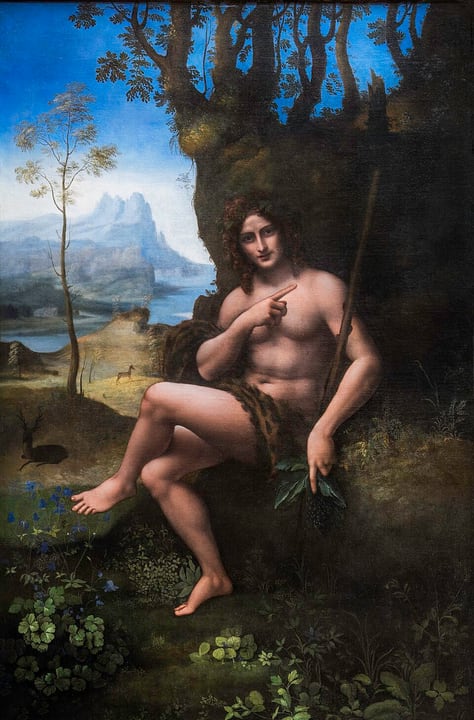
Bacchus, originally Saint John the Baptist, is a painting in the Musée du Louvre, Paris, France, by the Italian Renaissance artist Leonardo da Vinci and Francesco Melzi, while in Leonardo's workshop. Sydney J. Freedberg assigns the drawing to Leonardo's second Milan period. Among the Lombard painters who have been suggested as possible authors are Cesare da Sesto, Marco d'Oggiono, Francesco Melzi, and Cesare Bernazzano. The painting shows a male figure with garlanded head and leopard skin loincloth, seated in an idyllic landscape. He points with his right hand off to his left, and with his left hand grasps his thyrsus and also points down to earth.
The painting originally depicted John the Baptist. In the late 17th century, between the years 1683 and 1693, it was overpainted and altered to serve as Bacchus.
The model for the John the Baptist / Bacchus / Angelo incarnato series was Salaì.
Cassiano dal Pozzo remarked of the painting in its former state, which he saw at Fontainebleau in 1625, that it had neither devotion, decorum nor similitude, the suavely beautiful, youthful and slightly androgynous Giovannino was so at variance with artistic conventions in portraying the Baptist – neither the older ascetic prophet nor the Florentine baby Giovannino, but a type of Leonardo's invention, of a disconcerting, somewhat ambiguous sensuality, familiar in Leonardo's half-length and upward-pointing Saint John the Baptist, also in the Louvre.
The overpainting transformed the image of St. John into one of a pagan deity, by converting the long-handled cross-like staff of the Baptist to a Bacchic thyrsus and adding a vine wreath. The fur robe is the legacy of John the Baptist, but has been overpainted with leopard-spots relating, like the wreath, to Bacchus, the Roman god of wine and intoxication.
- Artist
- Francesco Melzi
- Date
- 1510s
- Collection
- Louvre, Paris, France
- Movement
- High Renaissance, Lombard school
- Medium
- oil paint, walnut panel, transferred on canvas
- Size
- 177 × 115 cm
Story adapted from the Wikipedia article and its contributors, licensed under CC BY-SA 4.0. Facts from Wikidata (CC0). Image: Public domain, Wikimedia Commons.

Explore paintings by Francesco Melzi
Explore related paintings
- An Old Man and his Grandson by Domenico Ghirlandaio
- Bonaparte at the Pont d'Arcole by Antoine-Jean Gros
- Bonaparte Crossing the Alps by Paul Delaroche
- Bonaparte Visiting the Plague Victims of Jaffa by Antoine-Jean Gros
- Charles I at the Hunt by Anthony van Dyck
- Death of Sardanapalus by Eugène Delacroix
Guess famous paintings in the free daily art puzzle →
Enable JavaScript to play the interactive puzzle. Your progress stays on this device.