
Train your eye
Learn to recognize paintings
You do not have to memorize a whole painting at once. Start with its largest color areas, look for the arrangement of light and dark, then connect those clues to a subject, title and artist. Try the exercise below before you open the answer.
1. Start with the palette
Look for the dominant colors and the smaller accents. Is most of the image dark, pale, warm or cool? Write down two colors and one contrast before guessing. Color alone rarely identifies a painting; use it to narrow the possibilities.

2. Read the arrangement
In this game, each vertical stripe averages one narrow slice of the original image. The left-to-right order remains, but shapes and vertical positions disappear. A dark stripe might come from a tree, a figure or a shadow. Treat that as a hypothesis to test when the mosaic or soft-focus clue appears.
3. Compare your guess with the original
Before revealing, predict a subject: portrait, landscape or still life. Then compare the image with your notes. Which clue helped, and which was misleading?
Reveal the worked example
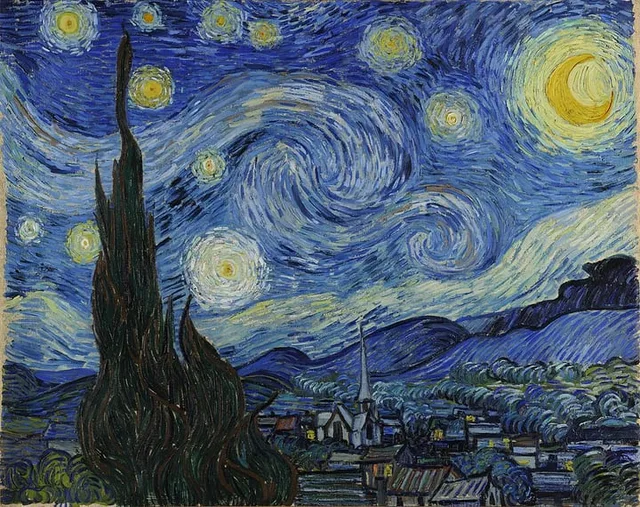
The Starry Night by Vincent van Gogh. Compare the blues and yellows with your notes. The dark cypress on the left and the bright sky become much easier to distinguish when the shapes return.
Read the story of The Starry Night.
Image: Public domain, Wikimedia Commons source. Artist and collection facts: Wikidata.

4. Make one memorable connection
After each reveal, connect the title, artist and one visual feature in a sentence. Revisit the painting later through the painting library. The aim is to recognize a work in another context, rather than remember where an answer appeared on a quiz.
Try the clues in the game
The color code is worth 100 points, the mosaic 70 and the soft-focus view 40. A wrong painting answer scores zero. Finding the museum adds 50. Use free practice to experiment without affecting your daily score; practice draws from the full catalog and is not an artist-specific lesson.
Put it into practice
Use a short round to test one observation at a time. The daily puzzle and unlimited practice are free, with no account required. The daily challenge offers five paintings and up to 750 points.