The Raft of the Medusa
Théodore Géricault · 1819
The story
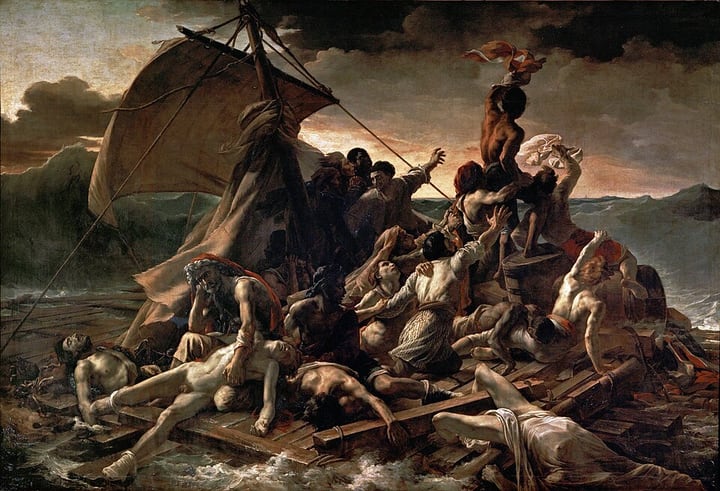
The Raft of the Medusa —originally titled Scène de Naufrage —is an oil painting of 1818–1819 by the French Romantic painter and lithographer Théodore Géricault (1791–1824). Completed when the artist was 27, the work has become an icon of French Romanticism. At 491 by 716 cm, it is an over-life-size painting that depicts a moment from the aftermath of the wreck of the French naval frigate Méduse, which ran aground off the coast of today's Mauritania on 2 July 1816. On 5 July 1816, at least 150 people were set adrift on a hurriedly constructed raft; all but 15 died in the 13 days before their rescue, and those who survived endured starvation and dehydration and practiced cannibalism. The event became an international scandal, in part because its cause was widely attributed to the incompetence of the French captain. Géricault chose this large-scale uncommissioned work to launch his career, using a subject that had already generated widespread public interest. The event fascinated him.
- Artist
- Théodore Géricault
- Date
- 1819
- Collection
- Louvre, Paris, France
- Movement
- Romanticism
- Medium
- oil paint, canvas
- Size
- 491 × 716 cm
Story adapted from the Wikipedia article and its contributors, licensed under CC BY-SA 4.0. Facts from Wikidata (CC0). Image: Public domain, Wikimedia Commons.
.jpg)
Explore paintings by Théodore Géricault
Explore related paintings
- Portrait of a Kleptomaniac by Théodore Géricault
- The 1821 Derby at Epsom by Théodore Géricault
- An Old Man and his Grandson by Domenico Ghirlandaio
- Bacchus (Leonardo) by Francesco Melzi
- Bonaparte at the Pont d'Arcole by Antoine-Jean Gros
- Bonaparte Crossing the Alps by Paul Delaroche
Guess famous paintings in the free daily art puzzle →
Enable JavaScript to play the interactive puzzle. Your progress stays on this device.