Nocturne in Black and Gold – The Falling Rocket
James McNeill Whistler · 1875
The story
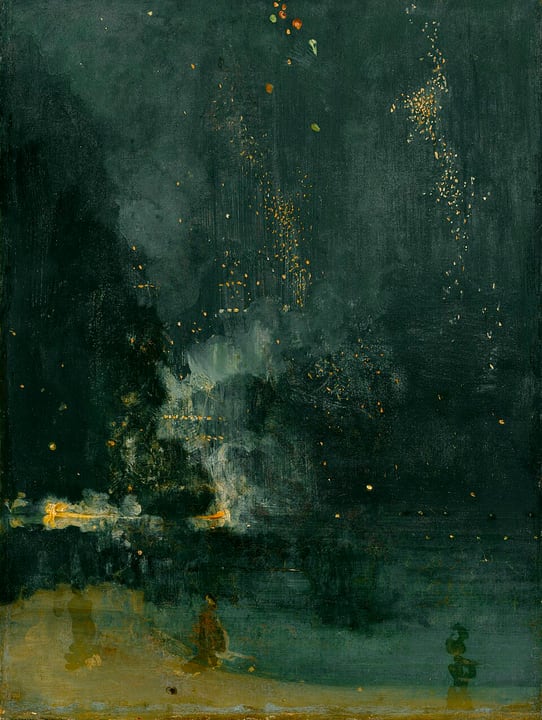
Nocturne in Black and Gold – The Falling Rocket is a c. 1875 painting by James McNeill Whistler held in the Detroit Institute of Arts. The painting exemplified the art for art's sake movement – a concept formulated by Pierre Jules Théophile Gautier and Charles Baudelaire.
First shown at the Grosvenor Gallery in London in 1877, it is one of two works (the other being Nocturne in Black and Gold – The Firewheel) inspired by the Cremorne Gardens, a celebrated pleasure resort in London. One of his many works from his series of Nocturnes, it is the last of the London Nocturnes and is now widely acknowledged to be the high point of Whistler's middle period. Whistler's depiction of the industrial city park in The Falling Rocket includes a fireworks display in the foggy night sky. Nocturne in Black and Gold – The Falling Rocket is most famously known as the painting behind the lawsuit brought by Whistler against the art critic John Ruskin.
The painting was featured in the 1980 BBC Two series 100 Great Paintings.
- Artist
- James McNeill Whistler
- Date
- 1875
- Collection
- Detroit Institute of Arts, Detroit, United States
- Movement
- Tonalism
- Medium
- oil paint, panel
- Size
- 60.3 × 46.4 cm
Story adapted from the Wikipedia article and its contributors, licensed under CC BY-SA 4.0. Facts from Wikidata (CC0). Image: Public domain, Wikimedia Commons.

Explore paintings by James McNeill Whistler
Explore related paintings
- Nocturne: Blue and Silver – Chelsea by James McNeill Whistler
- Symphony in White, No. 1: The White Girl by James McNeill Whistler
- Symphony in White, No. 2: The Little White Girl by James McNeill Whistler
- Whistler's Mother by James McNeill Whistler
- The Nightmare by Henry Fuseli
- The Nut Gatherers by William-Adolphe Bouguereau
Guess famous paintings in the free daily art puzzle →
Enable JavaScript to play the interactive puzzle. Your progress stays on this device.